
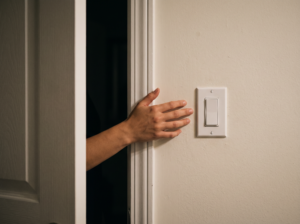
It’s 3 a.m. You need the bathroom. You swing your legs out of bed, turn left, and stop. Wait. Is it left? You reach for the light switch, and your hand finds bare wall.
Welcome to week one in your new home.
That moment of confusion isn’t a sign you made the wrong move. It’s your brain doing exactly what it’s built to do: running the map of a house you no longer live in. The good news? The strangeness has a timeline. And once you understand it, you can stop waiting for the house to feel like home and start helping it get there.
Why 90 Days?
Two pieces of research shape this calendar.
The first is about habits. A well-known study from University College London followed people as they built new daily habits. On average, it took 66 days for a behavior to become automatic, with a huge range from 18 days to more than 250. The takeaway isn’t a magic number. It’s that “automatic” takes about two months for most of us, and longer for some. That’s normal.
The second is about moving later in life. Studies of older adults who relocate find that adjustment takes time, that feeling safe and at home is the marker that it worked, and that positive social connections play an outsized role in getting there.
So the 90 days fall into three phases, each with its own job: map the house, make it yours, belong to it. Your brain needs all three, in roughly that order.
Days 1–30: Map It
Your old house had decades of wiring behind it. Your brain knew it so well you could walk it in the dark. In the new house, you’re starting from zero, and everything takes conscious effort. That’s why the first month is so tiring, even on days when you’re not doing much.
Your job this month is to give your brain a map as fast as possible. That means repetition and consistency.
- Give every daily item one fixed home on day one. Keys, glasses, phone, wallet, medication. Pick a spot and never change it. Every search burns energy your brain needs for learning.
- Use the same routes. Same path to the kitchen in the morning, same path to bed at night. Repetition is how a map gets drawn.
- Light the night path. A few plug-in night lights between bedroom and bathroom turn the 3 a.m. moment from disorienting to routine, and they help prevent falls.
- Walk outside every day. Same loop at first. Your brain needs to map the neighborhood, not just the house.
- Finish one room completely, and make it the bedroom. Sleep is when your brain consolidates what it learned during the day. A calm, finished room helps it do that.
Self-Check at Day 30
Does my hand still go to the old light switch? If it does, keep going. If you’re getting it right more often than not, the map is forming.
Days 31–60: Make It Yours
Here’s where most people stall. The essentials are unpacked, life is functioning, and the last dozen boxes migrate to the garage or the spare room, where they quietly sit for three years.
You know my take on that: clutter is deferred decisions. Those boxes aren’t storage. They’re a to-do list your brain keeps running in the background. Every time you walk past them, part of your mind says “not done yet.” That’s the opposite of home.
Your job this month is to close the open loops.
- Set a box deadline. Pick a date inside this window. Every remaining box gets opened, and every item gets a decision: keep it and give it a home, or let it go.
- Hang the art. Bare walls tell your brain you’re visiting. Pictures on the wall tell it you live here.
- Adjust to what the house is teaching you. Where do things pile up? Which chair do you actually use? Which room do you avoid? Rearrange around what you see, not around how the old house was set up. (I go deeper on this in Don’t Rebuild the Old House.)
- Start one-in, one-out now. A fresh space fills up fast. The habit you build in month two is the one that sticks.
Self-Check at Day 60
Are there any boxes left? Any room I avoid? Any “for now” spots that have quietly become permanent?
Days 61–90: Belong to It
A house can be perfectly mapped and beautifully arranged and still not feel like home. What usually finishes the job isn’t a thing. It’s people.
That’s what the research keeps pointing to: social connection is one of the strongest drivers of a successful adjustment after a move. In this phase, your brain is learning something new. Not “where’s the bathroom,” but “who are my people here?”
Your job this month is to build familiar faces.
- Go where the same people go. The same coffee shop at the same time, the same class, the same pool hours. Familiarity is built by repetition, with people as much as with places.
- Say yes to one invitation a week. Potluck, card game, walking group. You don’t have to love all of them. You just have to show up.
- Introduce yourself to the neighbors on both sides. Five minutes at the mailbox counts.
- Find one way to be useful. Volunteering is the fastest shortcut I know from newcomer to neighbor. When people count on you, you belong.
Self-Check at Day 90
Can I name three people here who’d stop to say hello if they saw me at the store?
What If You’re Behind Schedule?
Then you’re behind schedule. That’s all it means.
Remember the range in that habit study: some people needed 18 days, some needed more than 250. If you moved after a loss, a health scare or a long, painful sale, your timeline may stretch. That’s not failure. It’s a heavier load.
What matters is that you keep moving through the phases instead of getting stuck in one. If you’re at day 75 with boxes still in the garage, go back to month two’s job. If the house is perfect but you haven’t met a soul, jump ahead to month three. The order helps, but none of this is a test.
One honest note: if you’ve felt confused, anxious or low for weeks with no sign of it easing, talk to your doctor. Relocation stress is real, and you don’t have to push through it alone.
Day 91: The Moment You Stop Noticing
Here’s how you’ll know it worked. One evening, you’ll walk from the kitchen to the bedroom in the dark without thinking about it. Your hand will find the light switch on the first try. You’ll come home from the store and feel your shoulders drop as you pull into the driveway.
You won’t notice the house anymore. You’ll just live there.
That’s not luck. That’s 90 days of rewiring, done on purpose.
Start Tonight
Pick the one spot where your keys, glasses and phone will live from now on, and put them there before bed. That’s day one.
If you’re planning a move or a downsize and want a coach for the whole journey, from the first box to day 91, visit www.myclearpathliving.com.