
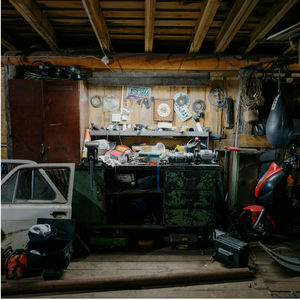
Here’s the thing nobody tells you about the garage: it was never meant to be a room. It’s a decision-deferral system with a garage door opener.
Every bin, every dusty box, every “I’ll deal with this eventually” pile in there is the physical residue of a choice you didn’t make. Keep it or toss it. Fix it or replace it. Use it or admit you won’t. You didn’t decide. You just… relocated the decision. Out of the house, into the garage, out of sight. And now more than a third of American garages — 36% — are so cluttered that people can no longer park a car inside them.
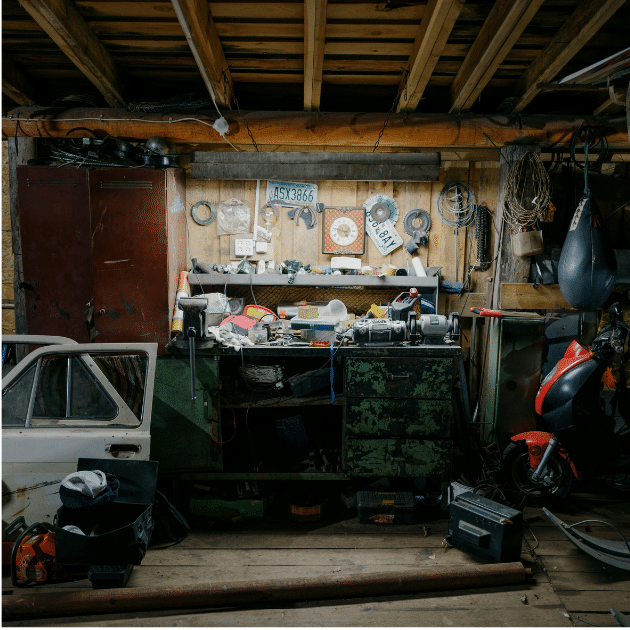
Read that again. Not “a little messy.” Not “could use some shelving.” Cluttered to the point where the space fails at its one non-negotiable job: holding a car. There are over 82 million garages in the U.S., and more than 60% of Americans with a garage say it’s the messiest room in their entire house. That’s not a storage problem. That’s tens of millions of households quietly avoiding thousands of small decisions, one cardboard box at a time.
Organizing Is Just Decision-Avoidance With Better Branding
This is where most garage content goes wrong. It hands you a pegboard system, color-coded bins, a “zone map” for your tools versus your sports gear versus your seasonal decor. And sure, it’ll look great for a photo. But you haven’t decided anything. You’ve just built a nicer shelf for your indecision to live on.
Organizing lets you avoid the actual question. Decluttering forces it. That’s the whole difference, and it’s why one works and one doesn’t.
Look at what’s actually piling up out there, because the categories are almost never random — they’re the exact categories of stuff that require a decision you don’t want to make:
- Tools you bought for one project. You needed it once. You told yourself you’d need it again “someday.” Someday hasn’t shown up in three years.
- Kids’ toys and gear the kids have outgrown. Nobody wants to be the parent who threw away the bike. So it sits. Forever, technically, unless you decide.
- Sports equipment from a hobby you don’t do anymore. The tennis racket. The snowboard. The weight bench you assembled once. Keeping it isn’t “staying ready” — it’s postponing the admission that that season of your life is over.
- Anything you didn’t want in the house but couldn’t bring yourself to get rid of. This is the real function of a lot of garages. Not storage — exile. If it were good enough to keep, it’d be inside. It’s not in the house because some part of you already decided it doesn’t belong. You just haven’t finished the sentence.
That last one is the tell. The garage isn’t overflow storage for your home. For a huge number of households, it’s a halfway house for things you’ve already emotionally discarded but haven’t physically let go of.
The Data Backs This Up, and It’s Worse Than You Think
This isn’t just a feeling. It’s the majority experience.
One study found that disorganization — not a lack of space — causes 80% of household clutter. Not square footage. Not garage size. Decisions. Or the absence of them.
And the parking numbers make the deferral visible in the most literal way possible: a quarter of people with two-car garages don’t park in them at all, and a third can only fit one car — largely because of clutter. Other surveys back this up almost exactly: about a third of homeowners only use one side of a two-car garage for a vehicle because of clutter, and a fourth don’t park in their garage at all. One UCLA study went even further — researchers looking at 32 Los Angeles-area families found 75% of them weren’t using their garages for parking purposes at all.
Here’s my favorite stat, though, because it says the quiet part out loud: a third of homeowners don’t even know what’s currently stored in their own garage. Sit with that. You’re not just avoiding decisions about specific items — you’ve avoided so many decisions for so long that you’ve lost track of what’s even in the queue. That’s not clutter. That’s decision debt, compounding.
And people know it’s a problem. Over three in five U.S. adults say the garage is the most cluttered space in their entire home, and more than half of Americans with garages say they’re unsatisfied with how it’s organized. Unsatisfied — but still not deciding.
What This Doesn’t Mean
This isn’t a case for burning everything you own or treating sentimentality as a character flaw. Some things genuinely deserve to live in a garage — a lawnmower, the winter tires, tools you use every month. Storage is a legitimate function. This isn’t about emptying the garage down to bare concrete.
It’s about being honest with yourself about which category each item actually falls into: things you use, versus things you’re storing because deciding felt harder than not deciding. Those are not the same category, even though they end up on the same shelf.
How to Actually Make the Decisions You’ve Been Avoiding
Skip the bins. Skip the labeling system. You don’t need infrastructure for indecision — you need to actually decide. Here’s how to do that today, in one pass:
- Pick up the item and ask one question: “Have I touched this in the last 12 months?” Not “might I need it.” Not “could this be useful someday.” Have you touched it. If no, you already have your answer — you just haven’t said it out loud yet.
- For tools: if you own a duplicate or a tool you can’t name the last project for, it goes. One of everything is enough. Two of everything is a museum for your uncertainty.
- For kids’ gear: if the kid it belonged to could walk in and not recognize it, it goes. Outgrown is outgrown. Keeping the bike doesn’t keep the age.
- For sports and hobby gear: if you’d need to relearn how to use it, that hobby is over. Let it be over. You’re allowed to be done with things.
- For the “doesn’t belong in the house” pile: ask why it’s not in the house. If the honest answer is “because I don’t actually want it,” that’s not a storage question. That’s already your answer.
No sorting into “maybe” piles. No storage bins bought specifically to store the things you couldn’t decide about — that’s just building infrastructure around your avoidance and calling it progress. Decide now, while your hand is already on the object.
Do One Shelf, Today
Not the whole garage. Not this weekend, when you’ll “really tackle it.” One shelf, right now, before you finish reading anything else today.
Walk out there. Pick the shelf or the corner that’s bothered you the most. Touch every item on it. Ask the 12-month question. Make the call — keep, toss, donate — and act on it immediately, not after you’ve built a system for acting on it later.
You don’t need a plan for your garage. You need twenty minutes and the willingness to finally decide.